An upcoming IPO has an odd advantage that most investors waste. For days, sometimes weeks, before the issue opens, the key document is already public. In the document, you can find the business, the financial numbers, the risks, and the promoter’s details easily. You may not get this advantage once the bidding starts and the market noise takes over.
Keep reading this guide, as it is built around that window. Here, we’ll show you what to look at while you still have time to think, what you can leave for later, and many key things.
Quick answer: An “Upcoming IPO” is basically a public issue that has been announced or filed but is yet to open for bidding. Before investing, you must first identify whether it’s a mainboard or SME IPO, and understand what really the business does. Plus, check its revenue, profit and cash flow, valuation, and price band, and how it plans to use the money. And, go through the risks, subscription, GMP and market conditions, as well.
What Is an Upcoming IPO?
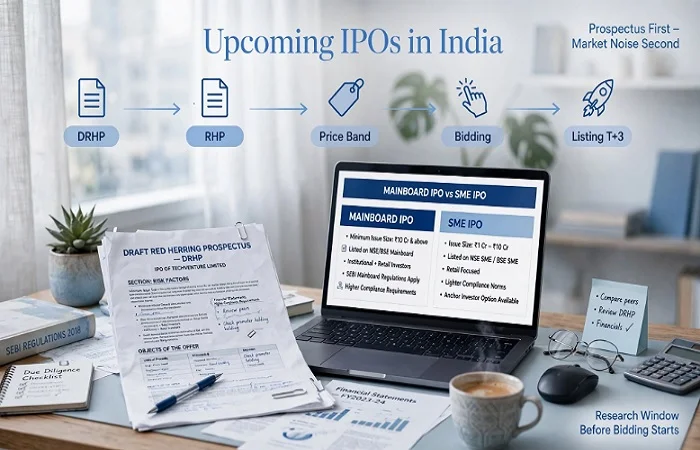
An upcoming IPO moves through a fairly predictable sequence:
- Announcement and DRHP: The company files a Draft Red Herring Prospectus with SEBI. This is often the earliest look you get at the business.
- RHP: After SEBI’s observations, the Red Herring Prospectus is filed with the final disclosures.
- Price band and dates. The price band, lot size, and opening and closing dates are announced, typically a few days before the issue opens.
- Bidding: The issue stays open for three working days.
- Allotment and listing: After the issue closes, shares are allotted to investors, and the stock listed three working days later (T+3).
Treat the DRHP stage as your research window. By the time the price band appears, you have only a few days.
Mainboard vs SME Upcoming IPOs
First of all, you need to check exactly what “type of problem” it is. It changes how you read everything that follows. Mainboard IPOs involve larger companies listing on the main platform of NSE or BSE. They usually have better liquidity and lower minimum investment amounts — around ₹14,000 to ₹15,000 for just one lot.
SME IPOs are mainly for smaller businesses that list on NSE Emerge or BSE SME. Lot sizes are larger, with a minimum investment that is usually ₹1 lakh or more, and trading after listing can be thin. A few sellers can push the price a long way down.
The practical rule: When the issue is smaller, the more you should rely on the prospectus and not on what the crowd is saying. If you want the longer comparison, the guide at https://maliktimes.in/mainboard-ipo/ lists current mainboard issues so you can see how they differ from SME ones.
8 Things to Check Before Applying for an Upcoming IPO
1. Understand the Company’s Business
The first thing to understand is how a company earns money. Then you need to check who the customers are, whether a few of them dominate sales, if income repeats, and whether the industry depends on policy or licenses. The industry report in the prospectus is prepared for the company, so don’t treat it as neutral research.
2. Check Revenue and Profitability
Read three years plus the stub period as a trend. In that, look for steady growth rather than a sudden jump just before the filing. Margins should also be stable, and the reported profit that actually turns into cash. Put profit after tax next to operating cash flow. A company showing profits for three years but little or negative operating cash flow has money stuck somewhere, and you should find out where.
3. Analyse the Company’s Valuation
Valuation is what most people ignore. It is ideal to check the P/E at the upper band, compare it with “2 or 3” listed peers of similar business and size, and ask whether faster growth justifies any premium. And, it’s better to use price-to-sales or EV/EBITDA for loss-making companies.
E.g.,: Let’s say if an IPO is priced at 40 times earnings, while similar listed companies trade at around 25 times, you are paying about 60% more. The company’s growth or returns should be good enough to justify that higher price.
4. Examine the IPO Price Band
The price band is the range within which you can bid. Work out the market capitalization at the upper end, and the amount for one lot (lot size × upper price). Retail bidders can invest up to ₹2 lakh, and the cut-off price option lets you bid at the final issue price. Remember that the price band is the company’s and bankers’ opening position. It is not a verdict that the stock is cheap.
5. Check How the Company Will Use the Funds
Under “Objects of the Issue,” separate the fresh issue (money into the company) from the OFS (money to selling shareholders). If most of the issue is OFS, ask who is selling and why. For the fresh issue, favor specifics such as capacity, locations and timelines. SEBI caps general corporate purposes at 25% of the fresh issue. If debt repayment is a big chunk, ask what the debt originally paid for.
6. Read DRHP/RHP Risk Factors
The important thing is to check the litigation, customer and supplier concentration, related-party transactions, promoter shareholding and pledges, and auditor remarks. If anything here worries you, that’s a legitimate reason to skip the issue.
7. Review Subscription and GMP
Once bidding opens, subscription data shows demand from QIBs, NIIs and retail investors. NII and QIB bids often arrive on the last day, so day-one numbers can mislead. GMP, covered below, is a separate and weaker signal. Read both as context after you’ve checked the business.
8. Consider the Broader Market Environment
An IPO doesn’t list on its own. A market fall between the issue closing and listing can reduce or even wipe out the expected gain. Check whether other IPOs recently listed above or below their issue prices, whether foreign institutions are buying or selling, and whether the sector is in or out of favor. If you’re looking for a listing gain, the market mood becomes even more important.
How GMP Can Help Analyze an Upcoming IPO?
GMP, (or “grey market premium”), is the unofficial amount above the issue price at which IPO shares are expected to trade before listing. If the upper band is “₹100” and the GMP is “₹20”, the grey market is signaling a listing near “₹120”.
Why it changes: GMP can go up with subscription numbers, market conditions, news and dealer activity. Sometimes the change can be seen within a few hours.
Why it can mislead: The grey market is “unofficial” and not regulated by “SEBI” or the exchanges (NSE/BSE). This is why GMP figures vary by sources. A high premium also does not tell you much about the company’s valuation, debt, or cash flow.
You can use GMP like a weather forecast for a picnic: it gives you some useful context. But, it is not a guarantee. Many issues have been listed well below what the GMP suggested.
How to Track Upcoming IPO Dates?
Good research starts with early notice. Track these:
- Opening and closing dates: this is your bidding window.
- Price band and lot size: announced shortly before the issue opens.
- Allotment date: usually a few working days after close.
- Listing date: typically “3 working days” after the issue closes.
- GMP and subscription updates: useful context, once you’ve done the fundamental work.
If you want to follow upcoming mainboard and SME issues with their dates, price bands, lot sizes, GMP and allotment details in one place, you can check https://maliktimes.in/upcoming-ipo/. It would be better if you cross-check anything you see there, or anywhere, against the RHP and exchange notices, because dates and price bands can change.
Common Mistakes When Investing in Upcoming IPOs
Following social media hype. A screenshot isn’t research, and some channels promote issues they benefit from.
Applying only because GMP is high. That means the crowd is excited, not that the business is sound.
Ignoring valuation. The best company in the sector can still be too expensive at the issue price.
Ignoring fundamentals. If you haven’t looked at cash flow, debt and promoter details, you haven’t evaluated the IPO.
Treating a trade as an investment. If you plan to sell on listing day, call it speculation and size the bet accordingly.
Upcoming IPO Investment Checklist
Use this before every application:
- I can explain the business model in two sentences.
- Revenue, profit and operating cash flow have all been healthy over three years.
- The P/E and other multiples are reasonable against listed peers.
- I know the price band, lot size and total amount I’d invest.
- I understand how the fresh issue money will be used, and who is selling in the OFS.
- I’ve read the litigation, promoter and risk-factor sections.
- I’ve treated GMP as sentiment, not proof.
- Subscription data doesn’t contradict my view.
- I’m comfortable with the risk, and with holding even if it doesn’t list at a gain.
If you can’t tick most of these, skip the issue.
| You May Like to Know: 10 Tips and Strategies for IPO Investment
Frequently Asked Questions
What is an upcoming IPO?
Ans. In simple terms, an “Upcoming IPO” is basically a public issue that a business has announced/filed. But it still hasn’t opened for subscription yet.
How do I analyse upcoming IPOs in India?
Ans. To analyse, go through the “DRHP” or “RHP”, check three years of revenue, profit, debt and cash flow, compare valuation with listed peers, review use of funds and risk factors, and then look at subscription and GMP.
What should I check before applying for an IPO?
Ans. The business model, financial trends, valuation, price band, how the funds will be used, risk factors and your own risk tolerance.
What is the difference between DRHP and RHP?
Ans. The DRHP is the draft filed with SEBI for review. The RHP is the near-final version issued before the IPO opens, with the price band and dates.
Is GMP a reliable guide for an upcoming IPO?
Ans. No. It’s an unofficial sentiment indicator that can change quickly and doesn’t measure business quality.
How can I decide whether an IPO is worth investing in?
Ans. One simple way is to ask if you’d be comfortable holding the company at that price even if the stock doesn’t move for a year. If your answer depends on a listing-day jump, you’re speculating.
Conclusion
In short, before an upcoming IPO, it is ideal to give yourself a bit of time. Meanwhile, read company details — go through the key numbers and compare its valuation against peers.
Most importantly, with IPOs, sometimes the better choice is simply “not to apply”. If an IPO passes your checklist, apply with confidence. If it doesn’t, there will always be another one next month.